Please access our latest offering of antique Japanese swords that are available for ownership. Be sure to send us questions on available swords through our contact page. If a sword is listed ON HOLD, you can still inquire in case the sword does comes available. We look forward to hearing from you.

Gendaitô · Shôwa era (March 1937)
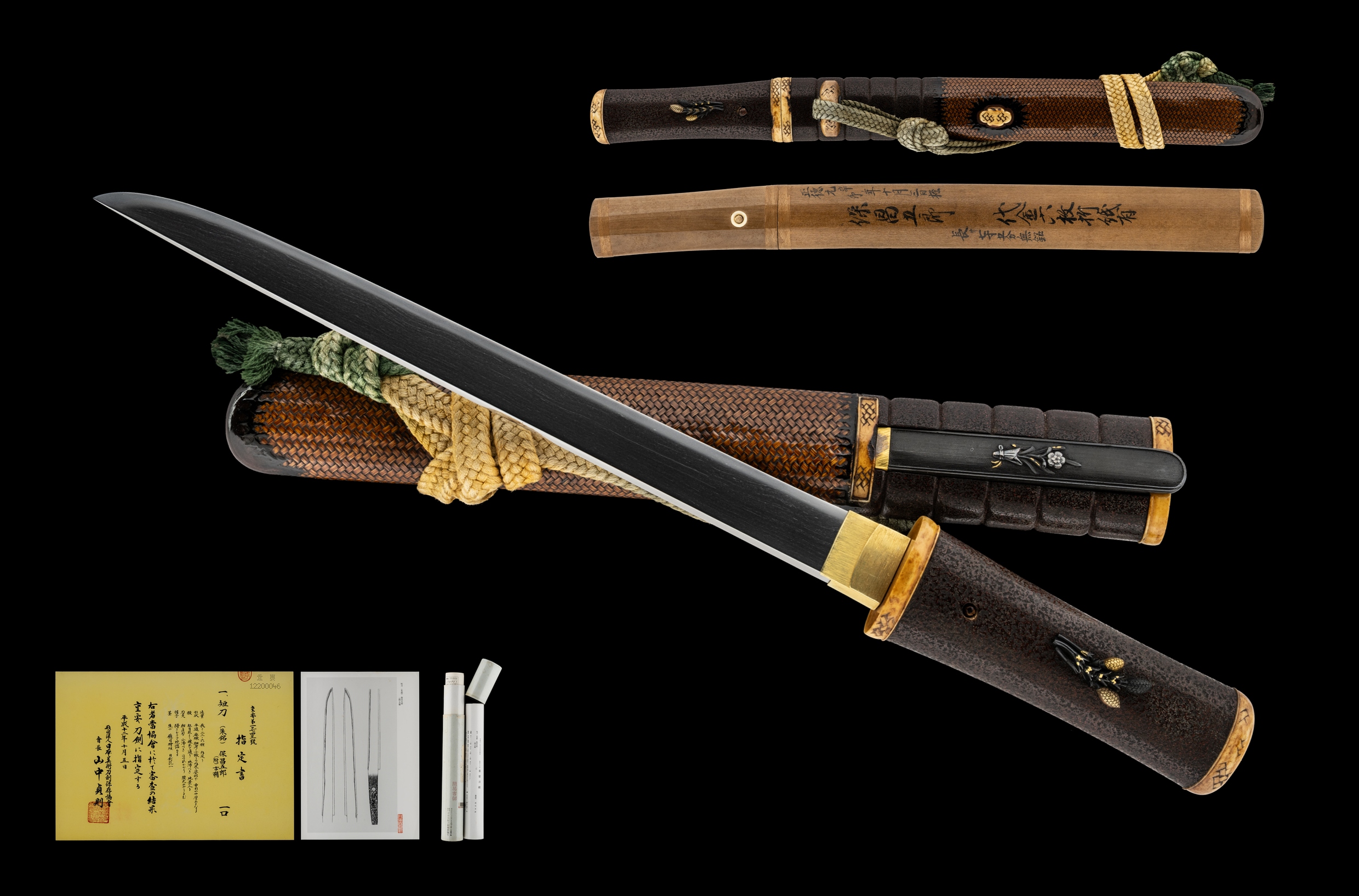
A Kurihara Akihide Tantô (栗原昭秀)
Kurihara Akihide was an extraordinary figure that mentored exemplary craftsmen such as Miyairi Yukihira and Amata Akitsugu. This delightful tantô was crafted by Akihide himself, and it carries a deeply personal history. It was presented as an omamori-tantô, a talismanic gift, to celebrate the birth of his granddaughter. The blade features a beautifully forged itame-hada, and the hamon is a flowing notare alive with kinsuji and sunagashi, ko-ashi and thick nie throughout. But a sword like this is much more than what can be seen in the steel. Following Akihide’s passing, his disciple Amata Akitsugu, himself destined to become a Living National Treasure, continued to visit Akihide’s granddaughter and personally maintained this blade each time he came. This is a tantô that deserves to be gifted again. Perhaps to celebrate a birth, as it once was. Whatever the occasion, let this tantô carry its story forward into a new home.
🔒 Available exclusively to UJ Email List members

Nanbokuchô · Ôan era (1368–1375)
A Takada Tokiyuki Katana (高田時行)
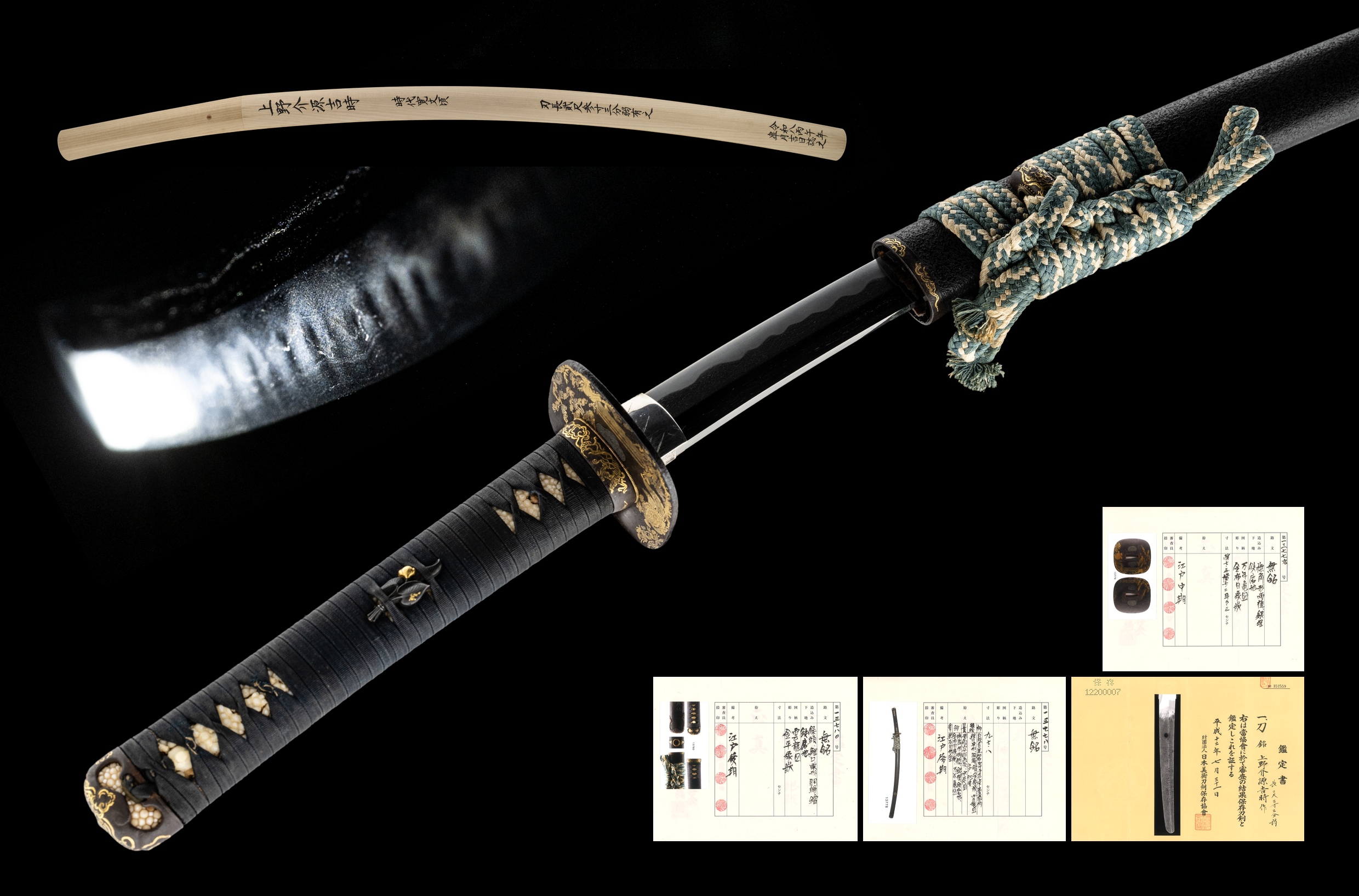
This superb katana by Tokiyuki from the Ko-Takada school will appeal to the collector that wants a true samurai sword, one that has been through the thick of it. Tokiyuki was the son of Tomoyuki, founder of the school, and rumoured disciple of the legendary Samonji. This weighty katana was crafted during the warring Nambokuchô period, some 650-years ago. It has a confident presence with healthy steel that features a jihada with flowing nagare-hada alive with deep chikei, ji-nie, and shirake utsuri. Its kirikomi (battle scar) says it all really. The sword is further housed in a superb Edo period samurai koshirae with Nishigaki iron tsuba, signed Miyazaki Sukenori shakudô fuchi-kashira, and toma-bune menuki still carrying traces of original gold. This is a katana with stories to tell.
🔒 Available exclusively to UJ Email List members

Chû-Kotô · Late Kamakura ~ early Nanbokuchô (1288–1342)
A Shikkake Katana (尻懸)
The Shikkake school, one of the five classic traditions of Yamato-den, was based in the Shikkake area behind Tôdai-ji temple in Nara. The school produced fine swords primarily for temple protection and identifiable by their skilled, distinctive workmanship. This katana is ô-suriage blade that retains a clean, graceful presence. The jihada is a glorious example of shikkake-hada combining mokume-hada with clear straight-lined masame-hada in the yakiba. The hamon is bright and wavy ko-gunome interwoven with ashi, sunagashi, kinsuji and tobiyaki. A beautiful set of koshirae centres around a gorgeous saya featuring luxurious mokume-style black and gold lacquer work that was inspired by the jihada of the sword. The tsuba is signed by Chôshu Tomonori and takes the form of a meaningful lotus flower and evokes a spiritual impermanence. Powerful gold cloud-dragon menuki embody both ferocity and protection, qualities revered by samurai warriors throughout Japan’s history.

Kotô · Late Nanbokuchô (c. 1390–1394)
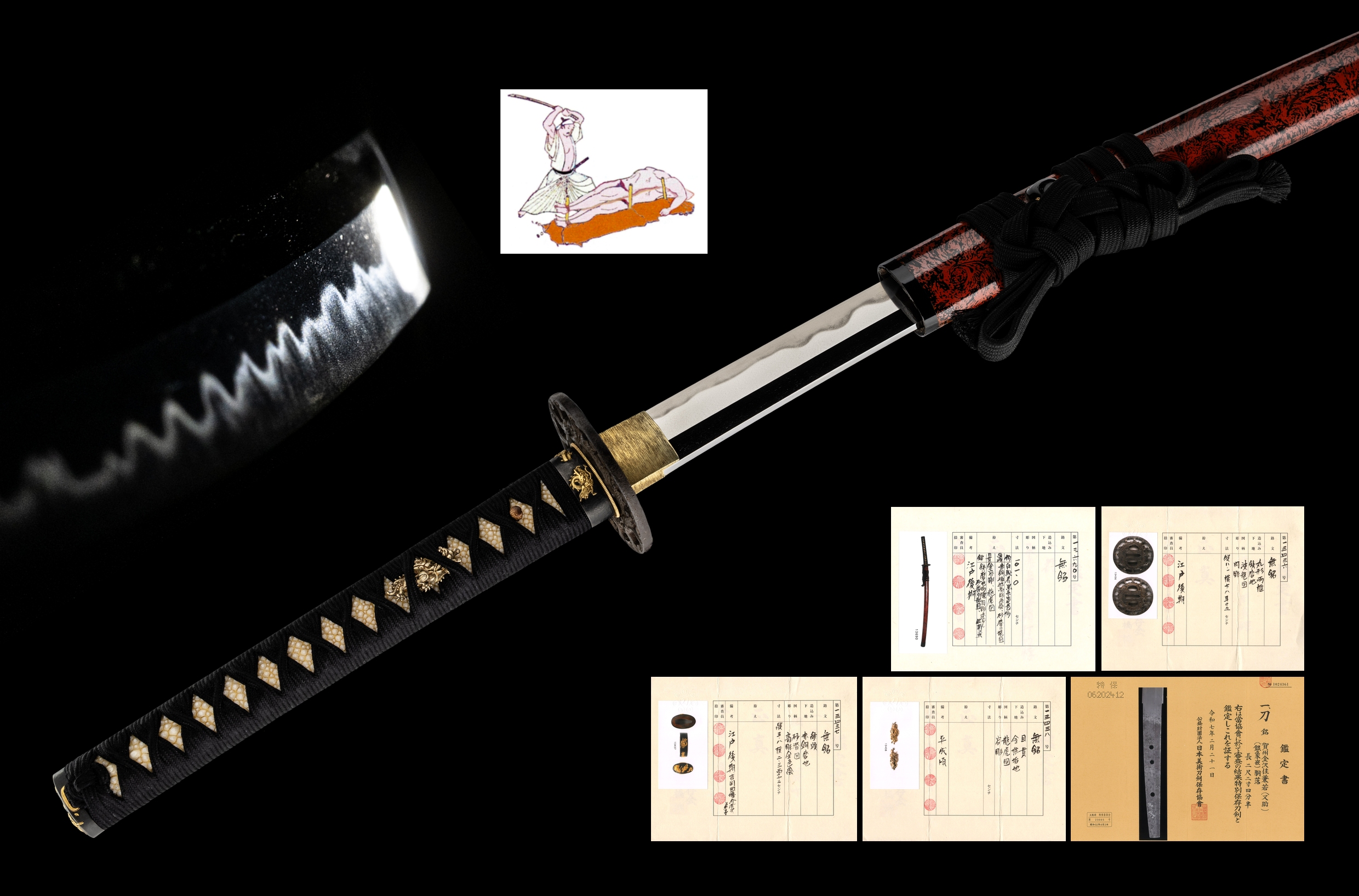
A Morihiro ‘Tameshigiri’ Katana (千代鶴守弘)
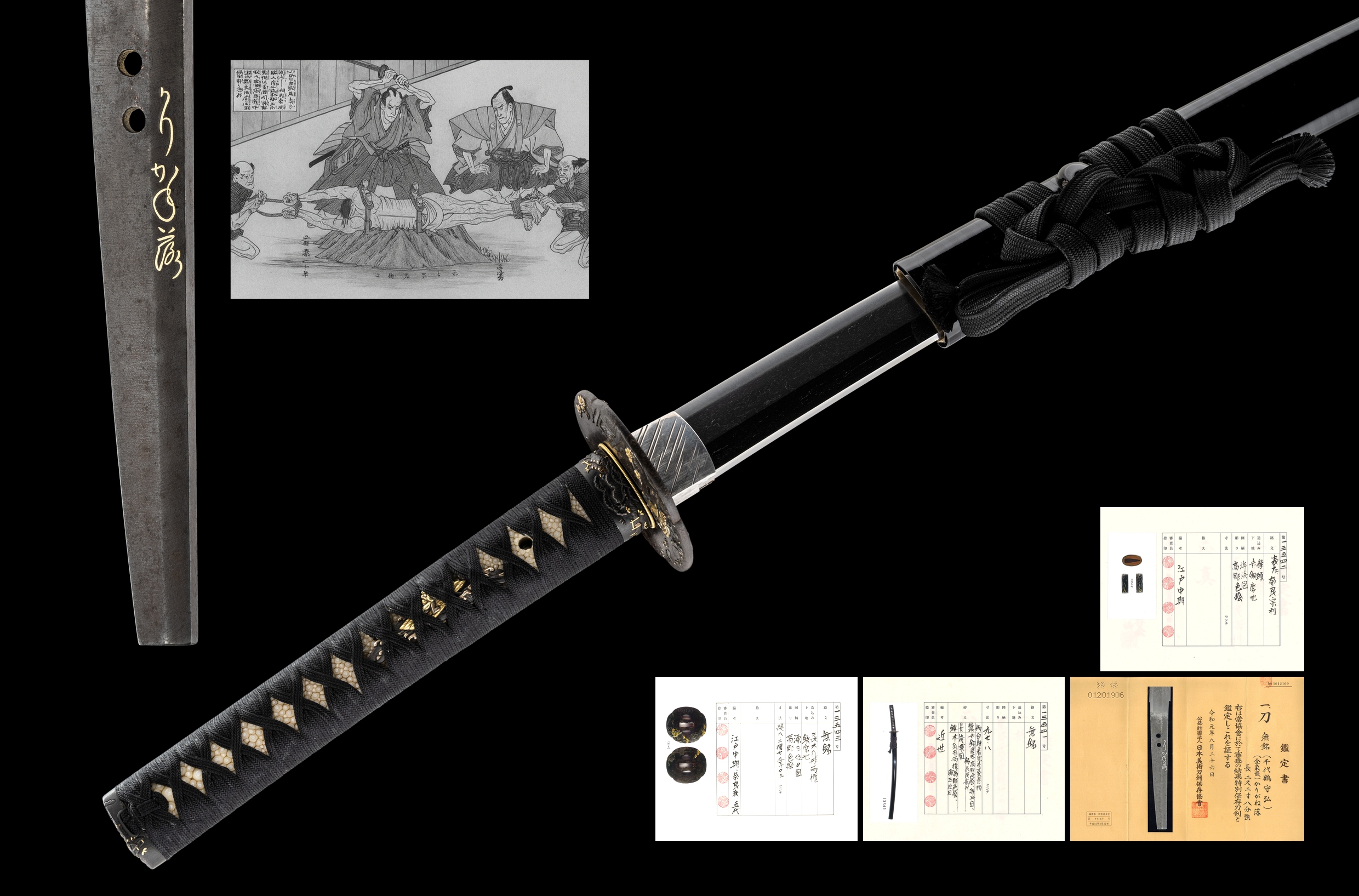
This powerful and extra sharp katana has been attributed to Chiyozuru Morihiro, a talented swordsmith who worked in Echizen during the late Nambokuchô period and into the Oei era of the Muromachi period. The blade displays a fine koshi-zori curvature and rich, dark jigane with abundant chikei and flows with itame and mokume-hada. Its bright hamon is based on suguha mixed with ko-midare, abundant ashi, sunagashi, kinsuji, and areas of nijuba. Kinzogan-mei on the nakago confirms this blade severed a human body through the armpit region during a tameshigiri cutting test. Kotô period swords with cutting tests are exceptionally rare to collect. The handsome koshirae features a striped senden-nuri saya and a tsuba depicting the heroic Minamoto Yorimasa, plus splendid fuchi-kashira of the open sea – both crafted by Munetoshi of the famed Nara school.
Shintô · Early Edo period (Kanbun era: 1664-1673)
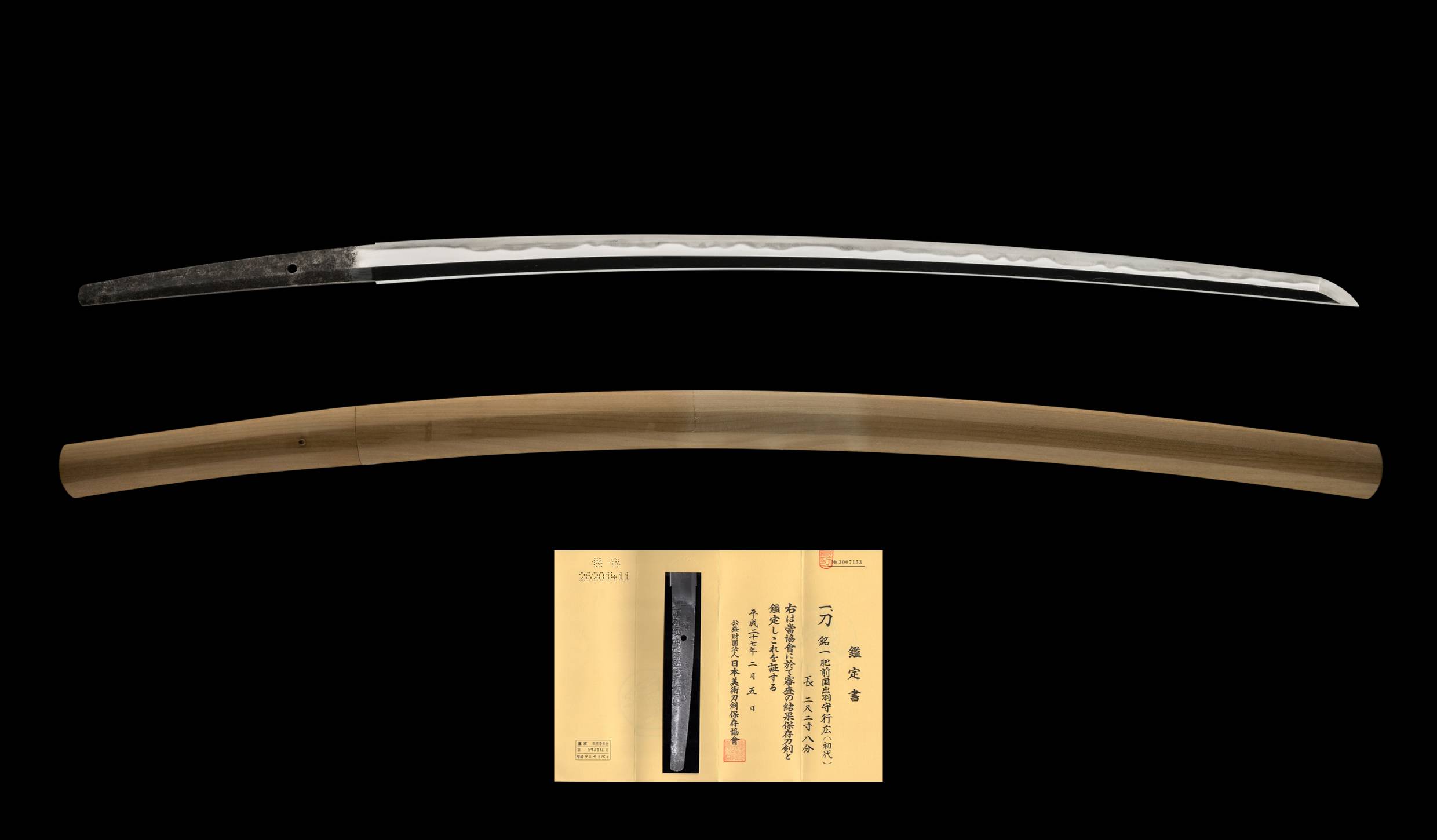
A Shodai Yukihiro Katana (肥前国出羽守行広)
Yukihiro was born in 1617 into the heart of the Hizen tradition, receiving his coveted Dewa no Kami title in 1663. This katana dates from his mature period – always the most desirable work of any Hizen smith. The blade presents the ko-itame jihada that defines the finest Hizen output, with a gunome midare hamon of lovely clove-blossom character, long ashi and sunagashi adding life across the steel. This sword has JUST come available (we sold it many years ago). Although not shown above, a custom Unique Japan koshirae accompanies the sword, ask for photos of the project. This sword is currently in Sweden with all import taxes paid, so easy to ship within Europe, but of course, it can be shipped most anywhere in the world. Ideal first sword to jump into the world of Japanese swords!

Shintô · Early Edo period (Jôô to Meireki era: 1652–1658)
A Nidai Kunisada Katana (和泉守国貞)
This is an early work by the smith the world would come to know as Inoue Shinkai, the Masamune of Ôsaka, saijô-saku grandmaster, and one of just nine swordsmiths of the entire Shintô period to reach that rank. Tanzan-sensei’s sayagaki places it in the Jôô to Meireki era (1652~1658), the formative years before Shinkai’s full genius had declared itself, and describes it as ‘overflowing with a sense of spirit’. The jihada is a beautifully refined ko-itame alive with rich chikei and sparkling ji-nie; the hamon features a thunderstorm of activity that includes kinsuji, inazuma, tama, tobiyaki, ashi and sunagashi. Its mid-Edo koshirae features a fabulously unique sendan-kizumi rattan saya wound in alternating vermillion and black, a gorgeous Kyô-Shôami shakudô tsuba in sayagata sukashi with gold rim, and an Akao school fuchi-kashira with wabi-sabi inspired golden maple leaves. There is something motivational in this katana, the energy of a young master at the very beginning of his ascent. Nidai Kunisada would go on to become the Masamune of Ôsaka, but this blade captures him earlier, in his 20s, hungry and brilliant, with everything still ahead of him. To own it is to carry that champion mindset forward.

Shintô · Early Edo period (Enpô era: 1673-1681)
A Yoshikane Katana (筑前住源信国吉包)
This spectacular katana was forged by Nobukuni Yoshikane, a central figure in the Chikuzen Nobukuni school, and retained smith of the Kuroda family. The hamon is a dazzling gunome-chôji-midare with brushed sunagashi that lights up the blade in the most fabulous way. The Higo-inspired koshirae was crafted as a unified whole – the harmony between the chrysanthemum tsuba and the cross-hatched petals on the kashira is pure class. Tanobe-sensei’s sayagaki described the sword as a healthy, superior masterpiece that demonstrates Yoshikane’s skill at the at the very height of his powers.

Shintô · Early Edo period (Kanbun era: 1661-1673)
A Sandai Yasutsugu Katana (江戸三代康継)
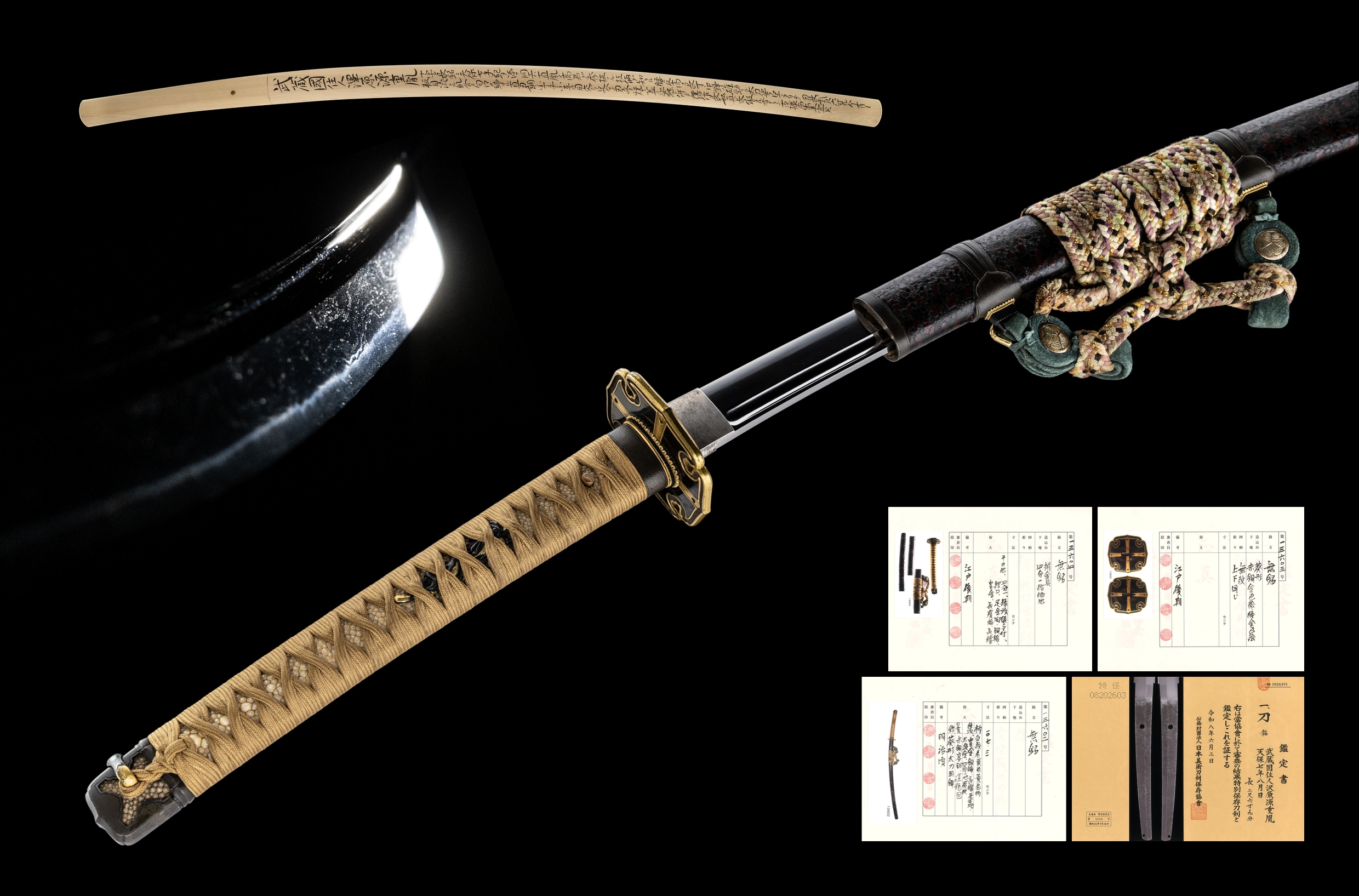
This striking katana is by third generation Edo Yasutsugu, with coveted aoi-mon via the Tokugawa family and forged with the use of Nanban-tetsu, foreign imported steel. A bright suguha hamon with brushed sunagashi, niju-ba and impressive kinsuji can be enjoyed quietly under the light. A spectacular Edo-period koshirae features gorgeous depictions of chidori birds inlaid in abalone shell and a marvellous fuchi-kashira with golden waves attributed to master Teruhide of the famed Ômori school. This is a brilliant samurai katana from the illustrious Yasutsugu school that will shine brightly in a lucky person’s Japanese sword collection.

Shintô · Early Edo period (Kan’ei era: 1624-1644)
A Shodai Masahiro ‘3-Body Tameshigiri’ Wakizashi (肥前国河内大掾藤原正廣)
At first glance, something very special announces itself about this long wakizashi by Maestro Hizen swordsmith Shodai Masahiro. The rare unokubi-zukuri configuration (Masahiro rarely made wakizashi let alone unokubi-zukuri) is immediately striking, and the explosive gunome-midare hamon fills the blade with energy. A kinzôgan gold-inlay inscription records a tameshigiri test performed on February 7th, 1664 by the renowned tester Yamano Ka’emon no Jô Nagahisa, in which he severed three bodies in a single stroke using this very blade. All at the age of 67, one of the last tested swords in his storied life. This spectacular wakizashi is an ideal sword to build a custom koshirae for (or enjoy in shirasaya only) and also a prime candidate for Tanobe-sensei sayagaki if his schedule permits.

Kotô · Late Kamakura (Karyaku era: 1326–1329)
A Jitsu'a Naginata-naoshi Wakizashi (実阿)
This stunning wakizashi from the very end of the Kamakura period is a naginata-naoshi by Jitsu’a, a superior swordsmith from Chikuzen province and the son of Sairen Kuniyoshi, who worked at the Hakata Dangisho – the institution established following the Mongol invasions to reinforce the defences of northern Kyûshû. While Jitsua’s son, the celebrated Samonji, would go on to embrace Sôshû methods, Jitsu’a himself remained faithful to classical Yamato-den interpretations. This wonderful blade features an eye-catching jihada with glorious pools of ô-itame-hada mixed with flowing nagare-hada. The hamon is a suguha rich in nie, with prominent kinsuji. This sword was awarded Jûyô Tôken certification in 1989 and comes with sayagaki by Tanobe-sensei that described the sword as a “superior work of simple, honest beauty that fully captures the smith’s unique style.”

Shintô · Mid Edo period (Kyôhô era: 1716-1736)
A Masafusa Katana (薩州住藤原正房)
This exceptional katana was forged by 3rd gen Masafusa of Satsuma province – a leading figure of Satsuma-Shintô school that combined the prowess of Mino-den with the intensity of Sôshû-den. This sword was crafted in 1727, deep into the mid-Edo period, and was once the property of Kenshiro Abbe, one of the foremost martial artists of the twentieth century. A man who, in fact, introduced aikido to the United Kingdom in 1955. Its brilliant set of Edo-period koshirae was built in the spirit of Satsuma warriors; decorated with carp amid waves from the famed Ômori school and dragon menuki make reference to the Dragon Gate legend, an emblem of perseverance, and of higher status.

Kotô · Late Muromachi (1394-1428 & 1500-1550)
A Sukesada & Yasunaga Daishô (祐定 ・ 康永)
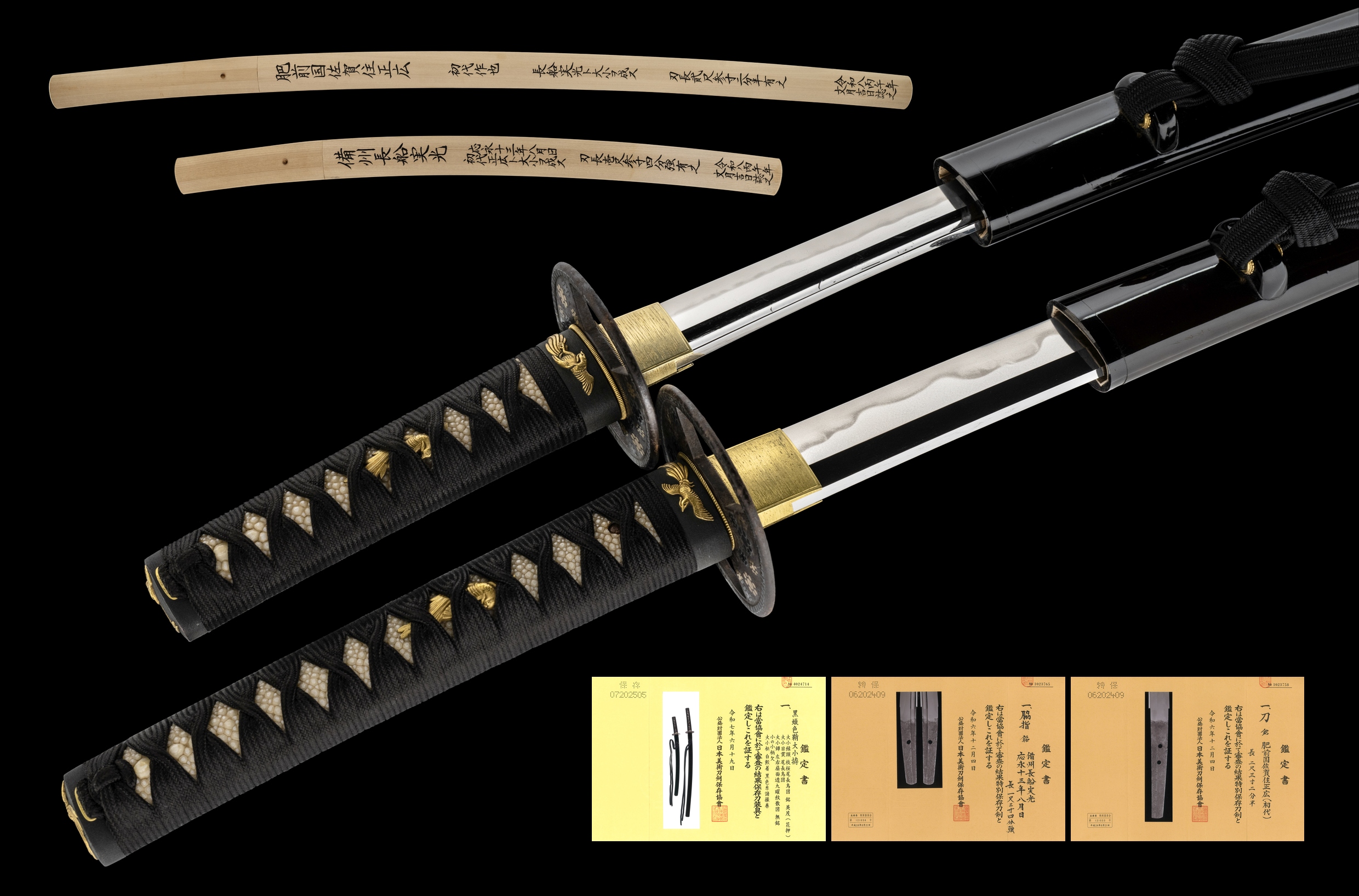
Here is a brilliant daishô formed of Muromachi period Bizen Osafune school swords by Sukesada and Yasunaga. The Sukesada katana is gloriously curved, with a jihada of itame mixed with mokume that stands out prominently. The wakizashi by Yasunaga, son of Ôei era master Yasumitsu, features abundant activity with a particularly bright nioiguchi. The daishô koshirae follows formal samurai daishô attire with shakudô fittings that display a powerful theme of dragons resulting in immense spiritual protection to the swords. There is fine energy channelled into this daishô, two war veterans from the Muromachi period now firmly in retirement, but always on the ready if ever called upon.
Shintô · Edo Period (Enpô Era: 1673~1681)
A Nidai Tadakuni Katana (肥前住播磨守藤原忠国)
This is a terrific katana by second generation Tadakuni, a jô-saku and wazamono ranked swordsmith that simply made quality swords for the samurai class. The blade features gorgeous, well-forged Hizen konuka-hada, a bright beautiful suguha hamon and everything is housed in a handsome late Edo-period dragon-themed koshirae. The Enpô era has a reputation for having had some of the finest swords crafted within this time frame and this blade is no exception. Other notable smiths from Enpô include Sukehiro and Kotetsu. If you have not started a Japanese sword collection yet, this curvy katana with loads of certificates is an ideal piece to kick start your nihontô journey.

Kotô · Late Muromachi (Tenbun~Eiroku eras: 1532-1570)
A Kanenori Tantô (兼法)
This special tanto is signed by Shodai Kanenori – a master Mino-den swordsmith active during the Tenbun to Eiroku eras known for his tanto and extended sunnobi tanto. Kanenori travelled from Mino to Echizen by way of a special invitation in 1536 from Asakura Takakage. Kanenori went on to lead the forming of the Echizen-Seki school. The sword’s spectacular Sôshû-inspired hitatsura hamon is composed of a bright gunome-midare with impressive islands of tobiyaki scattered across the blade. The beautiful accompanying koshirae is finished in aogai-mijin-nuri, decorated with lovely kurikata and saguri and features a hilt is carved and lacquered black with golden shisa lion menuki.The Gotô family and Shoami school fittings confirm this was a piece intended for private, high-ranking use. All told, this is a wonderful Mino-den tanto that will surely delight its new caretaker.

Kotô · Nanbokuchô period (Eitoku era: 1381-1384)
A Ko-Mihara Katana (古三原)
Ko-Mihara refers to the Mihara school that flourished in Bingo province (present-day Hiroshima) from the late Kamakura to the Nanbokuchô periods. Bingo province was renowned for producing high-quality iron and the strong reflection of the Yamato tradition is a result of the migration of skilled Yamato smiths to the region. This samurai sword is a classic beauty – an elegant masterpiece from the Ko-Mihara school that will appeal to the discerning collector with an eye for quality and keen detail. The wide suguha-hamon beaming over its exquisitely forged jihada is blessed with bountiful chikei and kinsuji displaying a quiet confidence. The NBTHK summed it up brilliantly in the sword’s jûyô tôken zufu certificate stating ‘the dignified form [of this sword] carries a sense of strength, while the minute activities along the edge offer refined taste and quiet beauty.’ That is exactly right.