
ITEM# UJKA490 – Catalogue 46 – Sold
A Nidai Tadakuni Katana (肥前住播磨守藤原忠国)
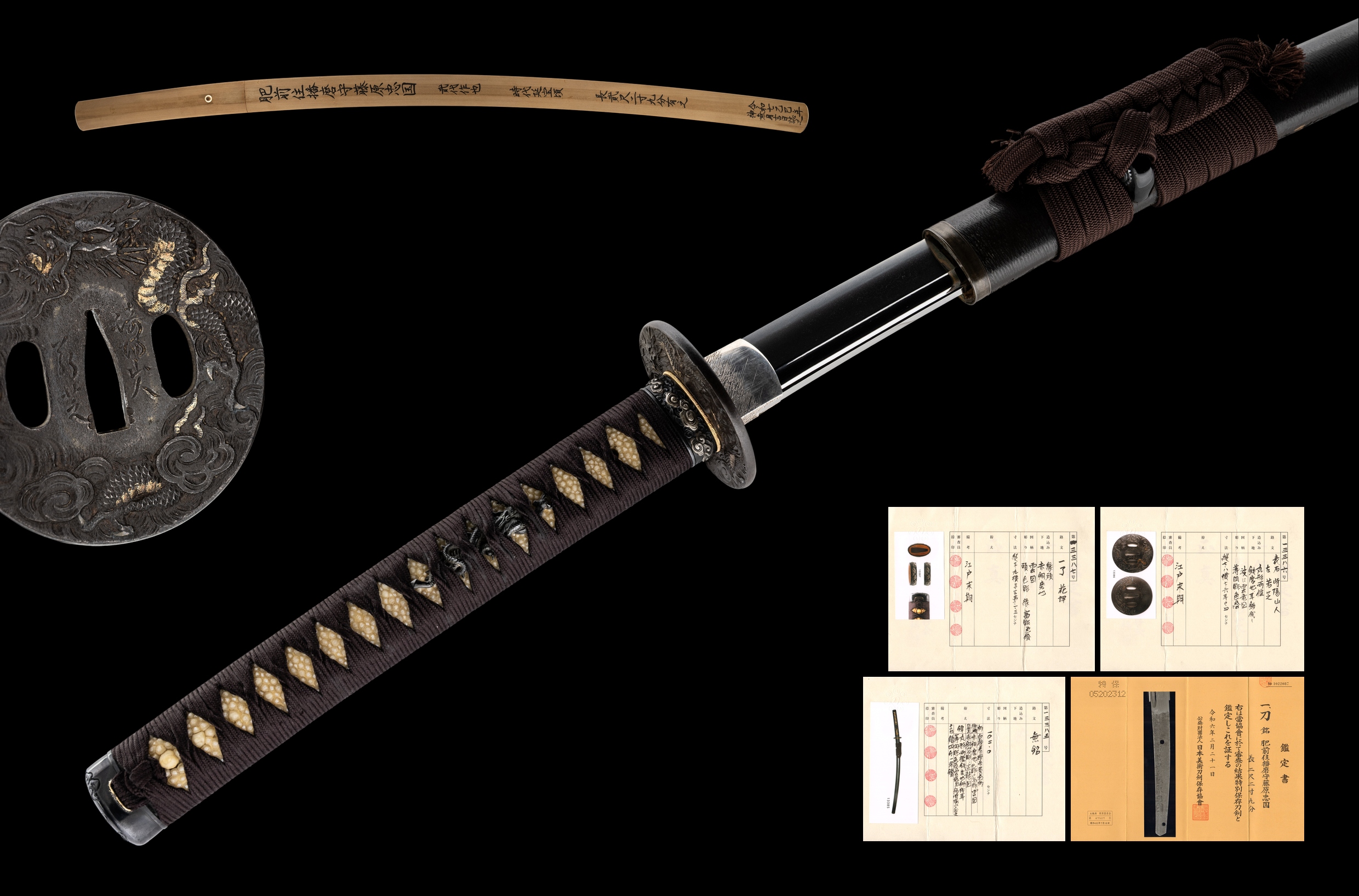
Second-generation Nidai Harima no Kami Tadakuni (播磨守忠国) inherited more than a name. His father, Shodai Tadakuni, had established the line as one of Hizen‘s most respected smiths, serving the Ogi branch of the Nabeshima clan in Saga province. With roots reaching back to grandmaster Hizen Tadayoshi, the school refined its craft across the Enpô and Genroku eras (1673~1704) – a period when Japan’s long peace was finally becoming prosperity, and swordsmiths were responding not to the demands of war, but to a new class of wealthy patrons who valued beauty and technical mastery above all else. Nidai Tadakuni blades earned the highest accolades: shintô jô-saku for craftsmanship and wazamonô for cutting ability. They were prestigious gifts exchanged between domains.
This katana carries the full Hizen signature. The ubu-nakago (original, unaltered tang) bears the complete mei in bold, confident cuts – Hizen-jû Harima no Kami Fujiwara Tadakuni. The jigane is textbook Hizen: a tightly forged ko-mokume scattered with ji-nie and gorgeous swirls of chikei that produce the famous konuka-hada texture – literally “rice-bran skin” – that makes Hizen steel shimmer like silk in the light. The hamon flows with serene confidence: a chû-suguha gently animated with ko-midare, the nioi deep and rich, with pockets of ko-nie and bright lines of kinsuji appearing as small gifts when the blade is tilted under the light. A subtle nijûbu-ba – where the hamon briefly splits and runs parallel – reflects the Yamato influence Tadakuni clearly admired. A spare hikae mekugi-ana near the base of the tang suggests this sword was mounted for genuine use, forged with practicality as well as beauty in mind.
The koshirae is a unified statement of cloud and dragon – classic symbols of power and transcendence. The saya is finished in aogai-mijin nuri over an ishime (stone-textured) ground: powdered mother-of-pearl applied over black lacquer that catches the light like dragon scales. The tsuba is a work of the Jakushi (若芝) school, signed Kiyô san-jin Jakushi (Jakushi from Nagasaki), depicting a dragon among clouds and waves in iron with atmospheric depth and quiet gold accents. The fuchi-kashira is signed Ichiryô (一了), a distinguished metalsmith of the late Edo period – the fuchi carved in sculptural high relief with rolling clouds, the kashira expressing the same motif through refined ke-bori line work. Shakudô menuki depict a crawling dragon clutching a nyoi-hôju – the sacred wish-fulfilling jewel. The tsuka is tightly wrapped hishimaki style in dark purple silk over beautifully aged samekawa. Every component speaks the same language.
| Swordsmith | Hizen-jû Harima no Kami Fujiwara Tadakuni (肥前住播磨守藤原忠国) |
| Period | Signed, Shintô Edo period (Enpô era: 1673~1681) |
| Nagasa | 69.6cm (ubu) |
| Sori | 2.0cm |
| Moto-haba | 2.99cm |
| Saki-haba | 1.89cm |
| Kissaki | 3.18cm |
| Moto-kasane | 6.4mm |
| Saki-kasane | 4.0mm |
| Nakago | Ubu-nakago (original, unaltered tang), 20.3cm, sujikai-yasurime (slanting file marks), ha-agari kurijiri tip, 2 mekugi-ana |
| Weight | 655g |
| Jihada | Splendid konuka-hada with wonderful ji-nie and plenty of chikei |
| Hamon | Brilliant chû-suguha with ko-midare, kinsuji in ko-nie deki |
| Certificate #1 | NBTHK Tokubetsu Hozon (issued Reiwa 6, February 21, 2024) |
| Certificate #2-4 | NTHK-NPO Kanteishô (koshirae, fuchi-kashira and tsuba certified as Authentic) |
| Fujishiro rank | Jô-saku (ranked as a superior swordsmith) |
| Sharpness | Wazamonô (rated as a maker of sharp swords) |
| Koshirae | Late Edo period (1780~1868). Aogai-mijin-nuri ishime-ji-fû-nuri saya. Tsuba by Jakushi school (signed Kiyô san-jin Jakushi). Fuchi-kashira signed Ichiryô (一了). Shakudô dragon menuki. Dark purple silk hishimaki over aged samekawa. |
| Habaki | Silver with rainfall file marks |
| Video | Watch Pablo’s video presentation on YouTube |
| Catalogue | Catalogue 46 |
| Status | Sold |
| Included | Shirasaya (with sayagaki), dragon koshirae, fabric bags, stand, kit, printed description |
The full catalogue PDF includes detailed photographs of the blade, nakago, koshirae components, certificates and sayagaki – along with in-depth historical notes on the Enpô era and the Hizen school.