
ITEM# UJTA069 – Catalogue 47 – Sold
A Kanenori Tantô (兼法)
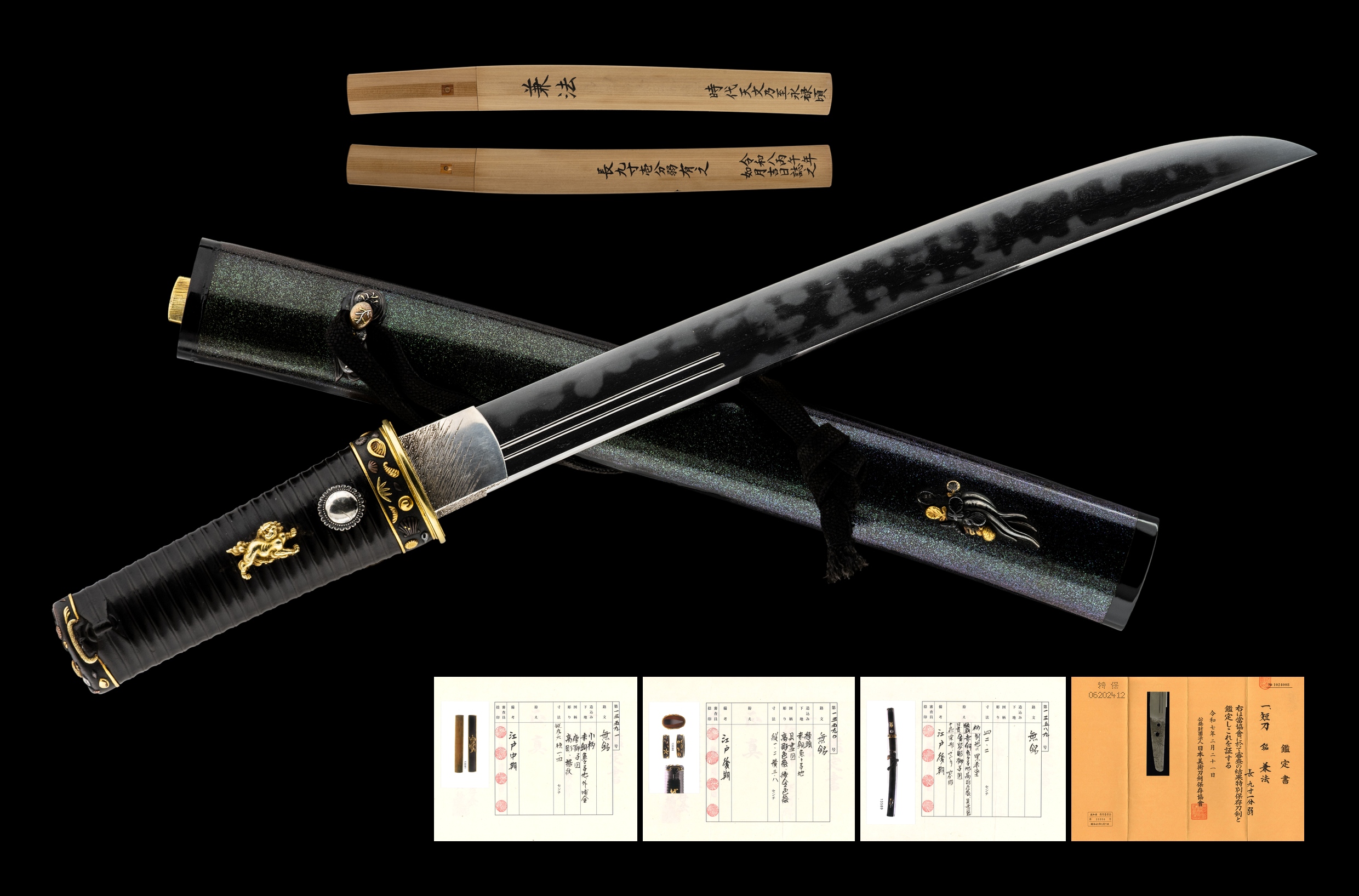
This tanto is signed by Shodai Kanenori, a master Mino-den smith working in the Sue-Seki tradition during the turbulent late Muromachi period. In 1536 he travelled from Mino to Echizen at the special invitation of the daimyô Asakura Takakage, settling at Ichijôdani and going on to found the Echizen-Seki school – one of the two principal sword-forging streams of Echizen in the years that followed. The Mino-den tradition itself traces back to Yamato, its character shifting decisively after Shizu Saburô Kaneuji, a student of Masamune, carried Sôshû-den influence into the province in the early Nanbokuchô period.
That dual inheritance is plainly visible here. The jigane is a tough mokume-hada blended with nagare-hada, threaded with sparkling chikei and a layer of icy ji-nie. Above it runs a spectacular Sôshû-inspired hitatsura hamon: a bright gunome-midare scattered with broad islands of tobiyaki that harden the full width of the blade, animated further by kinsuji and sweeping sunagashi. The effect is extraordinary, the hamon mirroring itself across much of the surface so the whole blade seems to come alive in the light. Carved goma-hashi and koshi-bi horimono point back to the ancestral Yamato-den tradition and its Buddhist associations.
The koshirae matches the quality of the blade and is consistent with daimyô ownership. The scabbard is finished in luxurious aogai-mijin-nuri using finely selected green mother-of-pearl, fitted with a kurikata worked as a seashell and a saguri in the form of a radish. The hilt is carved and lacquered black rather than silk-wrapped, mounted with golden shisa lion menuki, while a silver habaki over a copper ground completes the line. Gotô-school kozuka and Shôami-school shakudô fuchi-kashira – both NTHK-NPO certified – confirm a piece intended for private, high-ranking use. All told, this is a wonderful and historically rich Mino-den tanto that will delight its new caretaker each time it is drawn.
| Item Number | UJTA069 |
| Sword Type | Tantô |
| Swordsmith | Shodai Kanenori |
| Swordsmith (JP) | 兼法 |
| Signature | Kanenori |
| School | Seki (Sue-Seki) |
| Province | Mino |
| Period | Kotô – Late Muromachi (Tenbun~Eiroku eras: 1532-1570) |
| Nagasa | 27.6cm |
| Sori | 0.2cm |
| Moto-haba | 2.39cm |
| Moto-kasane | 4.6mm |
| Weight | 150g |
| Nakago | Ubu, higaki-yasurime, ha-agari kurijiri, two mekugi-ana |
| Jihada | Mokume-hada with nagare-hada, icy ji-nie and plenty of chikei |
| Hamon | Hitatsura in gunome-midare with kinsuji, sunagashi and tobiyaki |
| Certificates | NBTHK Tokubetsu Hozon (sword); NTHK-NPO Kanteishô (koshirae, fuchi-kashira & kozuka) |
| Sayagaki | Nozomi-san (shodô artist) – inscribed in the 6th month, Reiwa 7 (June 2025) |
| Koshirae | Aogai-mijin-nuri chiisagatana-koshirae, Late Edo period (1780-1868) |
| Fuchi-kashira | Shôami school, shakudô with nanako ground, seashell motif |
| Menuki | Golden shisa lions |
| Tsuka | Carved and lacquered black |
| Habaki | Silver with copper ground |
| Video | Watch Pablo’s video presentation on YouTube |
| Catalogue | Catalogue 47 |
| Status | Sold |
| Includes | Shirasaya, Edo koshirae, fabric bags, stand, kit, printed description |