
ITEM# UJKA468 – Catalogue 46 – Available
A Morihiro Tameshigiri Katana (千代鶴守弘)
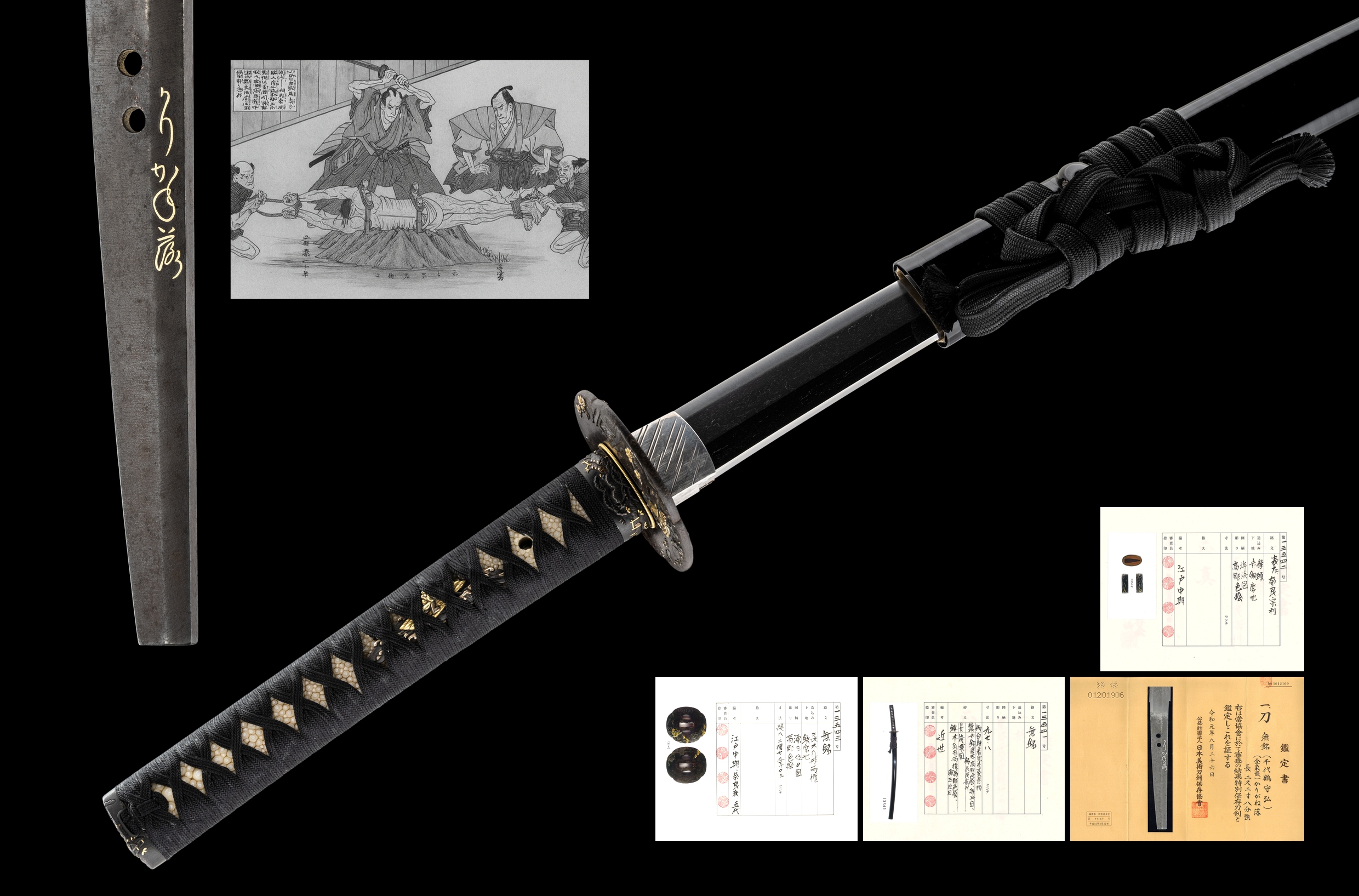
The Chiyôzuru school traces its origins to Rai Kuniyasu (来国安) of Yamashiro, a disciple of the celebrated Rai Kunitoshi (来国俊). Around 1337, Kuniyasu travelled to Echizen province in search of ideal spring water for forging, finding it at Takefu where he established his forge permanently. Upon settling there he adopted the name Chiyôzuru – meaning “a thousand cranes” – founding the lineage known as Echizen Rai (越前来). Chiyôzuru Morihiro (千代鶴守弘) is regarded as either a son or a direct disciple of Rai Kuniyasu, working through the late Nambokuchô period and into the Ôei era (1394-1428) of the early Muromachi. The name Morihiro was carried by successive generations who continued to shape sword production in Echizen, and Morihiro is ranked jô-saku – a superior smith – by Fujishiro.
The characteristic koshi-zori curvature of this blade – concentrated toward the base – dates it convincingly to the very late Nambokuchô period, around 1390. The NBTHK awarded Tokubetsu Hozon to this unsigned blade on the strength of its period characteristics alone, noting that the NBTHK only awards mumei swords this level of certification when they can be confidently dated prior to the Muromachi period. The rich, dark jigane is a beautiful mixture of flowing itame-hada and mokume, shot through with ample chikei – a dark, dense quality that reflects the forging traditions of the Hokurikudô region where the blade was made. The bright hamon is based on suguha mixed with ko-midare, with abundant saw-tooth ashi, sunagashi, kinsuji, areas of nijuba, and a fabulous kaen-bôshi that rises confidently like a candle flame at the tip. Adding a further layer of rarity, the nakago carries a gold kinzôgan inscription in cursive hiragana and kanji recording karigane-otoshi – the severing of a human body in a single stroke through the armpit region during a tameshigiri cutting test. Kotô period swords bearing cutting test inscriptions are exceptionally rare, and the test itself was likely performed during the shintô period, circa mid-1600s.
The handsome uchigatana-koshirae is lacquered in a glossy kuro-ro finish with sendan-nuri striping and certified authentic by the NTHK-NPO. Its fittings are of the first order: the tsuba and fuchi-kashira are both by Munetoshi (奈良宗利), fifth-generation master of the highly respected Nara school, working in the mid-Edo period. The tsuba depicts the heroic Minamoto Yorimasa on horseback amid pine and plum, with Ino Hayata on the reverse – the pair legendary for slaying the Nue monster that had terrorised the imperial court. The fuchi-kashira is a signed piece depicting a residence by the seashore through pine trees – marvellously detailed relief work that brings further harmony to the set. The menuki show a figure navigating rough seas on a raft. The silver habakiis beautifully carved with diagonal rainfall lines. The sword is currently with Tanobe-sensei for sayagaki inscription, which will accompany it to its new home.
| Item Number | UJKA468 |
| Sword Type | Katana |
| Swordsmith | Attributed to Chiyôzuru Morihiro (mumei) |
| School | Chiyôzuru (Echizen Rai) |
| Province | Echizen |
| Period | Kotô – Late Nambokuchô period (c. 1390-1394) |
| Nagasa | 69.2cm |
| Sori | 1.4cm |
| Moto-haba | 3.08cm |
| Saki-haba | 2.04cm |
| Kissaki | 3.15cm |
| Moto-kasane | 7.4mm |
| Saki-kasane | 5.4mm |
| Nakago | 20.0cm, ô-suriage, kiri-yasurime, kiri-jiri, 2 mekugi-ana |
| Weight | 820g |
| Jihada | Itame-hada and mokume-hada, dark jigane with ample chikei |
| Hamon | Ko-gunome based on suguha with kinsuji, sunagashi, ashi and nijuba |
| Boshi | Kaen-bôshi |
| Certificates | NBTHK Tokubetsu Hozon (sword); NTHK-NPO Kanteishô x 3 (koshirae, fuchi-kashira and tsuba) |
| Fujishiro Rank | Jô-saku |
| Tameshigiri (JP) | かりがね落 |
| Koshirae | Kuro-ro sendan-nuri saya uchigatana-koshirae (黒呂千段塗鞘打刀拵), Modern era; NTHK-NPO Kanteishô |
| Tsuba | Attr. Munetoshi (奈良宗利), fifth-generation Nara school; iron, depicting Minamoto Yorimasa on horseback and Ino Hayata (reverse); NTHK-NPO Kanteishô |
| Fuchi-kashira | By Munetoshi (奈良宗利), Nara school (signed); depicting a seashore residence through pine trees; NTHK-NPO Kanteishô |
| Menuki | Figure on a raft navigating rough waves |
| Tsuka | Hishi-maki, black tsuka-ito over white samekawa |
| Habaki | Silver habaki with rainfall carvings |
| Video | Watch Pablo’s video presentation on YouTube |
| Price | $22,500 |
| Catalogue | Catalogue 46 |
| Status | Available |
| Includes | Shirasaya, koshirae, fabric bags, stand, kit, printed description |
The PDF contains full photography, detailed blade analysis, and all certification documentation.