
ITEM# UJKA508 – Sold
A ‘Kane’ Katana (兼), 以下切 (末関)
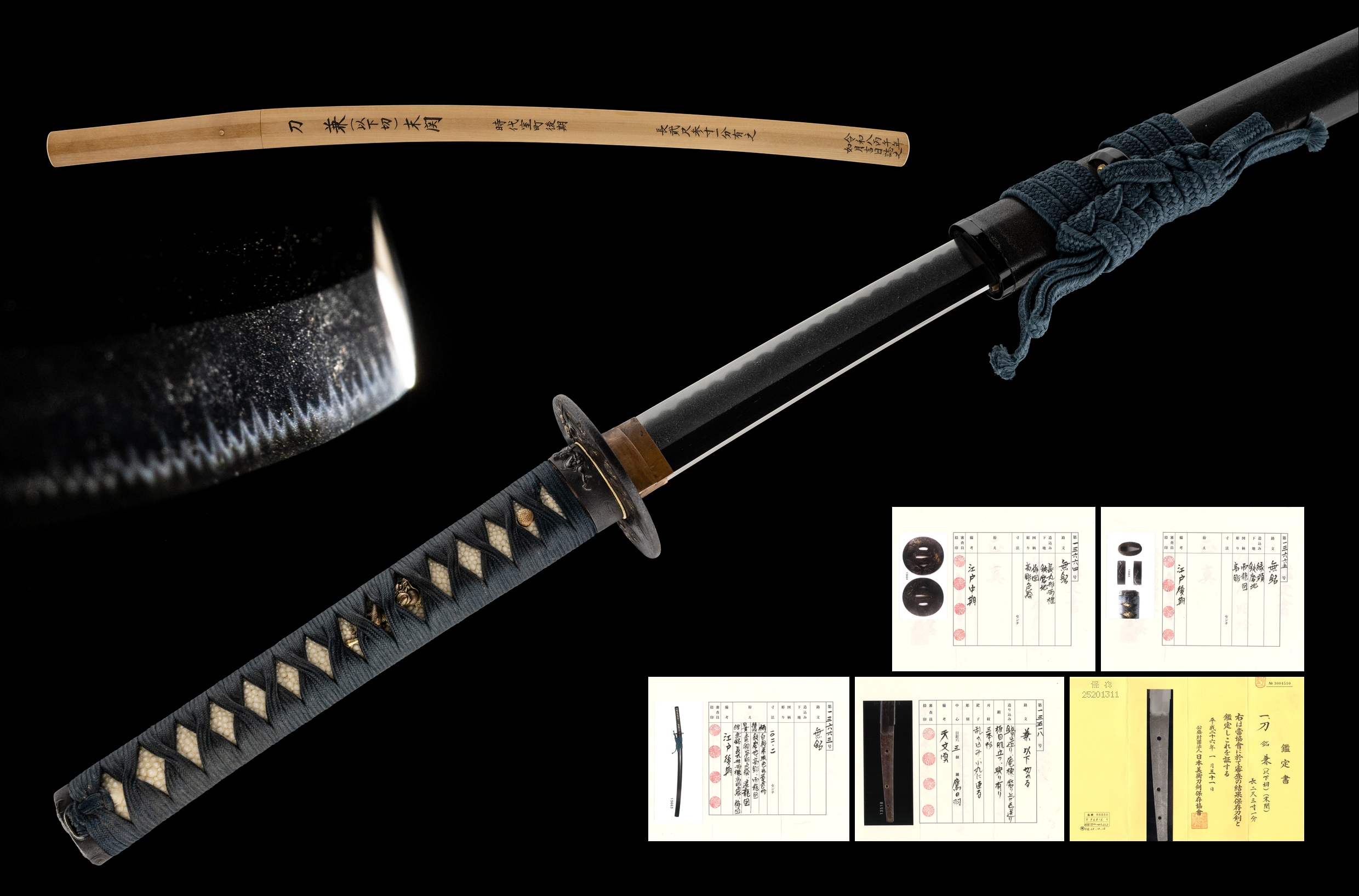
Sword production in Seki, in Mino province, traces its roots to smiths of the Kaneshige lineage who settled there toward the end of the Kamakura period, and by the late Muromachi period the district had become one of the great forging centres of Japan. The smiths active there after the Ônin War (1467-1477) are known collectively as Sue-Seki, prized for producing dependable blades built for the realities of the battlefield rather than for display. This katana carries that legacy directly: a shortened tang that once bore a fuller signature today preserves only a single bold character, 兼 (Kane), cut some five hundred years ago and still confidently struck.
The blade has been reduced from an original cutting edge of over 80cm, and while the NBTHK has left the smith unnamed, the NTHK-NPO has attributed the work to Kanemoto, one of the most celebrated names to emerge from the Sue-Seki tradition. The jihada is a well-forged itame-hada mixed with mokume-hada, threaded with chikei and touched by shirake-utsuri, and the hamon is a textbook sanbonsugi, its togari peaks rising every third pass like a heartbeat, a pattern synonymous with the Kanemoto line since the second-generation Magoroku Kanemoto originated it in the 1520s. The bôshi turns back in a soft midare-komi with a slight ko-maru kaeri, a hallmark of Mino swordsmithing.
The koshirae carries a story of its own. On the tsuba, the work of Nara Muneyoshi, fifth-generation head of the Nara school, a hawk stares down from among plum blossoms, gold-inlaid and sharp-eyed. That same hawk reappears in the takanoha yasurime cut into the nakago itself, hawk-feather file marks that echo the fitting above. The fuchi-kashira carries a young rain dragon caught mid-motion, still growing into its strength, while gilt copper menuki depict the dragon in its earlier, earthbound form. A sayagaki by Nozomi-san confirms the piece’s story in ink as well as in steel. For a collector taking their first step into Japanese swords, or seasoned hands drawn to a five-hundred-year-old blade with genuine presence, this is a rewarding place to start.
| Item Number | UJKA508 |
| Sword Type | Katana |
| Swordsmith | Kane (ika-kire) (Sue-Seki) |
| Swordsmith (JP) | 兼(以下切)末関 |
| Signature | Kane (only surviving character of a longer original signature) |
| School | Sue-Seki (Mino tradition) |
| Province | Mino |
| Period | Sue-Kotô – Late Muromachi (Tenbun era: 1532-1555) |
| Nagasa | 69.9cm (suriage) |
| Sori | 1.3cm |
| Moto-haba | 3.14cm |
| Weight | 675g |
| Nakago | Suriage-nakago (shortened tang) with kiri and takanoha yasurime (hawk-feather file marks), kurijiri |
| Jihada | Well-forged itame-hada with mokume-hada, shirake-utsuri and chikei |
| Hamon | Bright sanbonsugi with sunagashi, kinsuji and midare-komi bôshi |
| Boshi | Wavy midare-komi with a slight ko-maru kaeri |
| Certificates | NBTHK Hozon; NTHK-NPO Kanteishô (sword, koshirae, tsuba and fuchi-kashira certified Authentic) |
| Sayagaki | Nozomi-san (shodô artist) – inscribed in the 2nd month, Reiwa 8 (February 2026) |
| Koshirae | Kuro-ishime-ji-nuri saya uchigatana-koshirae, Late Edo period |
| Tsuba | By Nara Muneyoshi – iron with gold inlay, a hawk among plum blossoms |
| Fuchi-kashira | Rain dragon (amaryû) design |
| Menuki | Crawling dragon, copper with gold plating |
| Tsuka | White samegawa with navy blue tsuka ito |
| Status | Sold |
| Includes | Shirasaya, Edo koshirae, fabric bags, kit, printed description |
The PDF contains full photography, detailed blade analysis, and all certification documentation.