
ITEM# UJKA489 – Catalogue 46 – Sold
A Shodai Tadatsuna Katana (粟田口近江守忠綱)
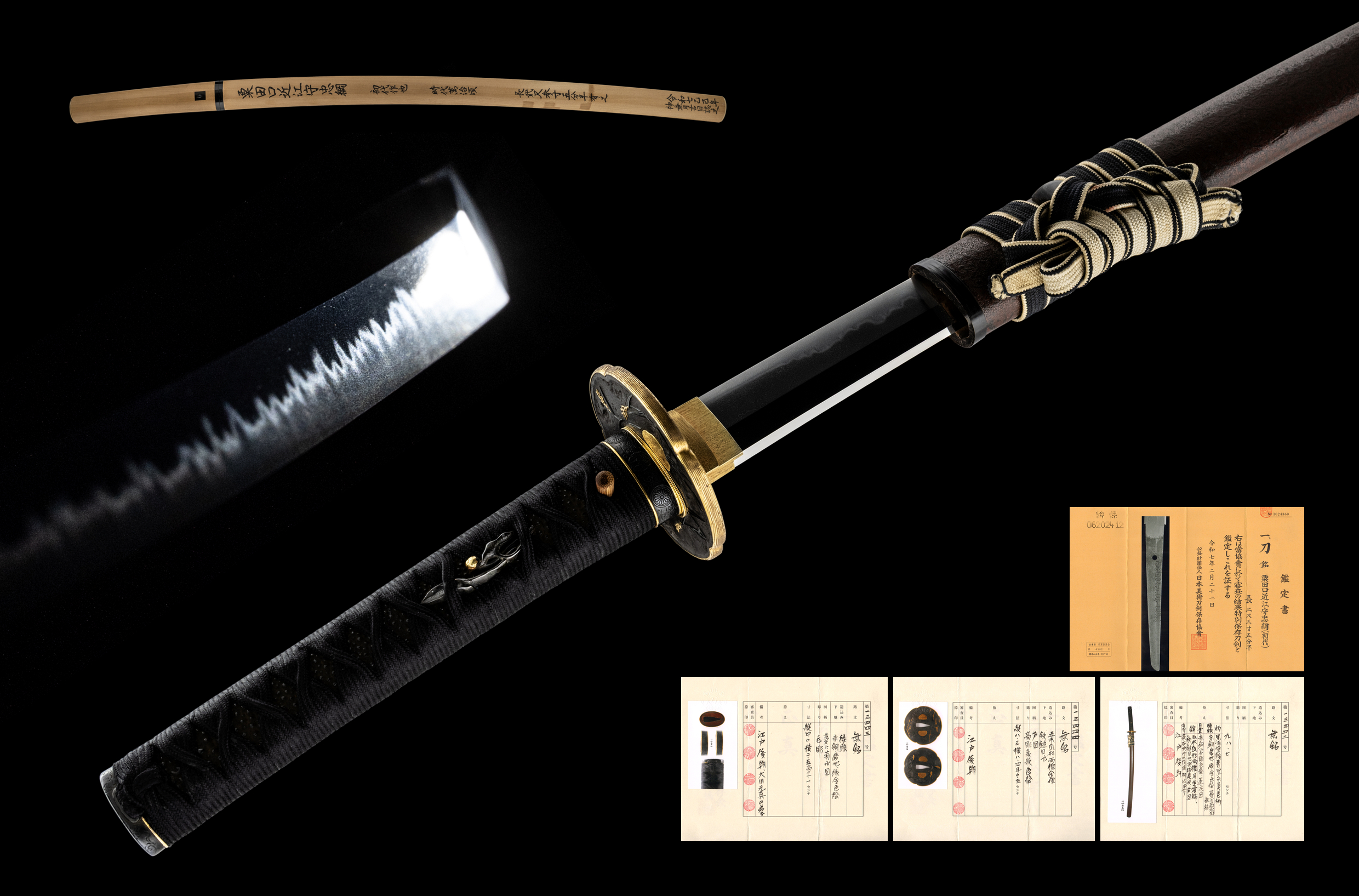
Awataguchi Ômi no Kami Tadatsuna (粟田口近江守忠綱), first generation, was born in 1609 in Himeji, Harima province. He began his career in Kyôto, absorbing the refined traditions of the capital before relocating to Ôsaka during the Keian era (1648-1652). A man with a strong sense of lineage, he regarded himself as a successor to the medieval Awataguchi tradition, a claim he expressed directly in early signatures such as “Awataguchi Fujiwara Tadatsuna.” He subsequently received the court title Ômi Daijô, and was later promoted to Ômi no Kami – the title carried by this sword. Fujishiro ranks him jô-saku (superior), and the rating wazamonô – a maker of reliably sharp swords – further underscores his standing among the finest smiths of the early Edo period. He worked until his death in 1676 at the age of 67.
This formidable katana is everything one expects from the Awataguchi name. The steel is forged to a superb density in a packed ko-itame whose nashi-ji surface is animated by thick ji-nie and abundant chikei – an unmistakable quality that gives the blade its characteristic weight and authority. At 825 grams in bare blade alone, it is a powerful, serious sword. The hamon is a glorious gunome-chôji-midare in ko-nie-deki, rising from a classic Ôsaka-yakidashi base before opening into lively clusters animated by long, sweeping kinsuji and brushed sunagashi. The ubu tang is original and unaltered, terminating in a ha-agari kurijiri – a characteristic shared by both the first and second generations of the Tadatsuna lineage – and carries the full, boldly chiselled eight-character signature with unmistakable confidence.
The late Edo period uchigatana-koshirae is lacquered in a deep red-brown cha-tsurume-ji-nuri finish – a rich arabesque texture that is subdued and thoroughly elegant. Its fittings are of exceptional quality. The tsuba is attributed to Myôchin Muneyoshi (明珍宗義), a late-Edo armourer working around 1800, and is forged on an iron plate with tall relief reeds and selective gold zôgan highlights; the gold fukurin rim and gold-filled hitsu-ana speak to a patron of real means. The fuchi-kashira is attributed to Chikuzanken Motohisa (築山軒元寿), disciple of the Mito domain’s official metalworker, executed in shakudô with chrysanthemum scrollwork in fine ke-bori – the fuchi interior bears the character 大 (dai), marking this as the katana half of what was originally a matched daishô set. The menuki depict lotus flowers in shakudô with gold-touched petals. The gold habakiis built over a copper foundation. All fittings carry NTHK-NPO Kanteishô. Both the shirasaya and the signed tsunagi carry sayagaki and tsunagi-gaki inscriptions by Nozomi-san, the accomplished shodô artist, dated October 2025.
| Item Number | UJKA489 |
| Sword Type | Katana |
| Swordsmith | Shodai Awataguchi Ômi no Kami Tadatsuna |
| Swordsmith (JP) | 粟田口近江守忠綱 |
| Signature | Awataguchi Ômi no Kami Tadatsuna |
| School | Awataguchi |
| Province | Settsu (Ôsaka) |
| Period | Shintô – Early Edo period (Manji era: 1658~1661) |
| Nagasa | 71.2cm (ubu) |
| Sori | 0.9cm |
| Moto-haba | 2.97cm |
| Saki-haba | 1.94cm |
| Kissaki | 3.06cm |
| Moto-kasane | 7.6mm |
| Saki-kasane | 4.8mm |
| Nakago | 21.3cm, ubu, ha-agari kurijiri, ô-sujikai-yasurime, 1 mekugi-ana |
| Weight | 825g |
| Jihada | Dense ko-itame nashiji-hada with thick ji-nie and plentiful chikei |
| Hamon | Gunome-chôji-midare in ko-nie-deki, Ôsaka-yakidashi, ashi, sunagashi, kinsuji |
| Certificates | NBTHK Tokubetsu Hozon (sword); NTHK-NPO Kanteishô x 3 (koshirae, tsuba, fuchi-kashira) |
| Fujishiro Rank | Jô-saku |
| Sharpness Rating | Wazamonô |
| Sayagaki | Nozomi-san (shodô artist) — Awataguchi Ômi no Kami Tadatsuna; shodai saku nari; Manji era; nagasa 71.2cm; inscribed on a lucky day in the 10th month, Reiwa 7, Year of the Snake (October 2025) |
| Habaki | Gold foil over copper |
| Koshirae | Cha-tsurume-ji-nuri saya uchigatana-koshirae (茶蔓目地塗鞘打刀拵), Late Edo period (1780~1868); NTHK-NPO Kanteishô |
| Tsuba | Attr. Myôchin Muneyoshi (明珍宗義), late Edo period, c. 1800; iron, tall relief reeds with gold zôgan highlights, gold fukurin rim; NTHK-NPO Kanteishô |
| Fuchi-kashira | Attr. Chikuzanken Motohisa (築山軒元寿); shakudô with chrysanthemum motifs in ke-bori; fuchi engraved with character 大 (dai), indicating original daishô pairing |
| Menuki | Lotus flowers in shakudô with gold-accented petals |
| Catalogue | Catalogue 46 |
| Status | Sold |
| Includes | Shirasaya with sayagaki, signed tsunagi, Edo koshirae, fabric bags, stand, kit, printed description |