
ITEM# UJKA473 – Catalogue 46 – Available
A Jôshû Kunishige Katana (城州住藤原国重)
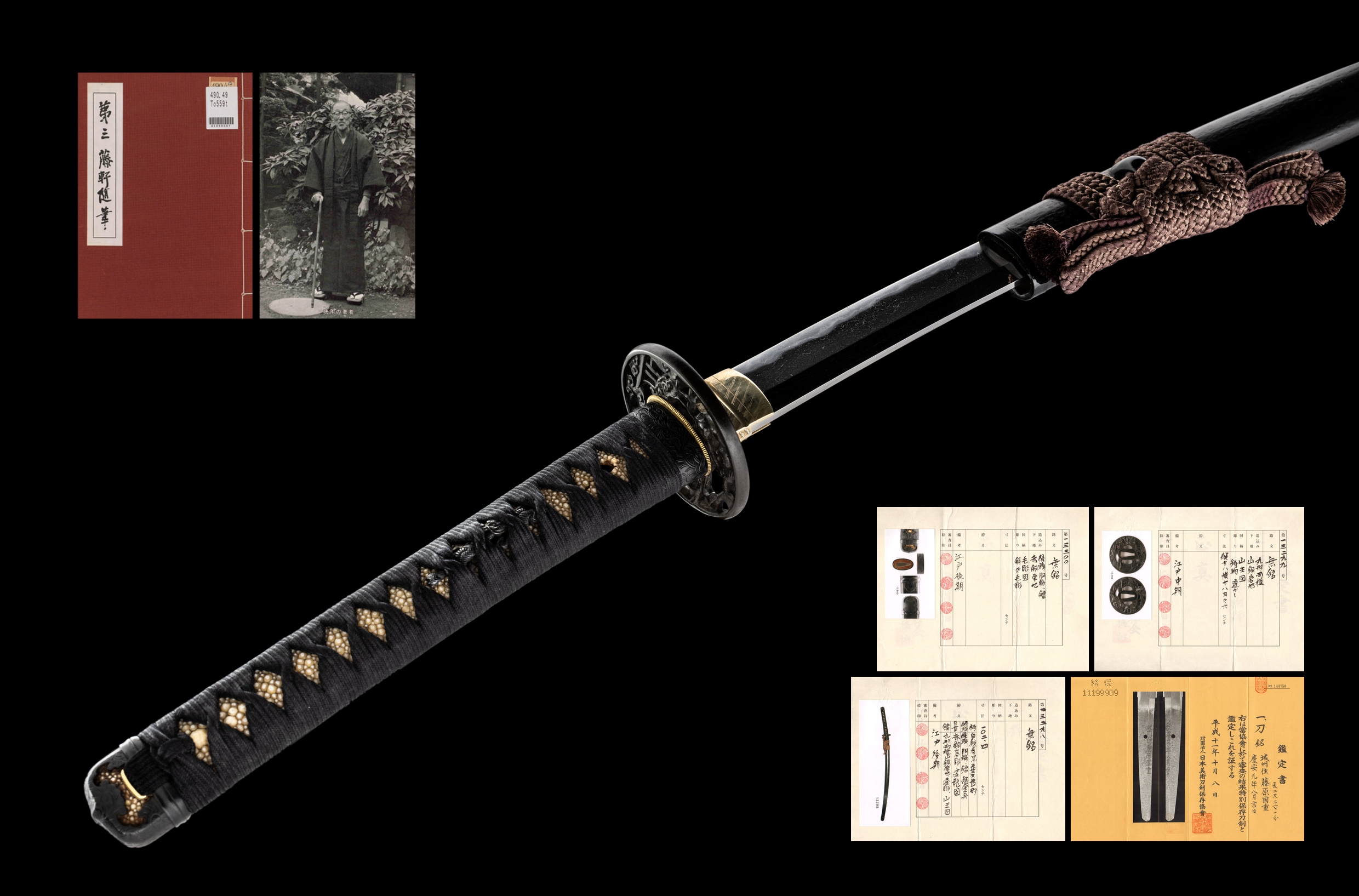
Jôshû Kunishige (城州住藤原国重) may not appear in the standard reference books, but this blade from the distinguished Mishina school tells its own compelling story. Around the Keian era (1648-1652) in Yamashiro province, swordsmiths displaying pronounced Mishina characteristics while using the “kuni” (国) character in their signatures were exceptionally rare. The lineage points squarely to Dewa Daijô Kunimichi (出羽大掾国路), top student of the great Horikawa Kunihiro (堀川国広). Compare the mei of both smiths: the highly stylised “kuni” character – written in a form not found in standard usage – is virtually identical between master and student. That is not coincidence; it is the deliberate transmission of a signature tradition. The nakago-jiri shaping, the yasurime, and the Fujiwara surname all confirm Kunishige as Kunimichi’s disciple.
This katana was forged in August 1648 – just months into the newly declared Keian era, when Japan sat under peak Tokugawa control. The third shôgun Iemitsu had sealed the borders nine years earlier, expelled every Jesuit, and driven the daimyô to financial exhaustion through the sankin-kôtai system. Within three years, disgruntled rônin would attempt the failed Keian Uprising – a desperate plot born from the very policies that defined this era. The blade aims squarely at the Shizu-inspired style that Kunimichi had mastered, and succeeds. The jihada is a spectacular mix of ô-mokume and flowing nagare-hada, with pronounced masame in the shinogi-ji, thick ji-nie, and abundant chikei. The hamon is an explosive gunome-midare with active ko-ashi, vivid kinsuji, sweeping sunagashi, peaks of togari, and big swells of notare in the monouchi. The bôshi enters in notare, finishes with slight hakikake, and turns back toward the mune – the characteristic Mishina-bôshi that is itself a statement of attribution. NBTHK Tokubetsu Hozon certification confirms the assessment.
The sword carries one of the most remarkable provenance stories in the Unique Japan archive. This very blade appears in Token Zuihitsu (Token’s Essay) by Dr. Katsumi Toriumi, where text written in November 1945 records that it was confiscated by U.S. Forces after the war. The sword was a Shintô piece given to Dr. Toriumi by his grandfather Masayasu shortly after he was born. Confiscated in November 1945, it was taken to the United States – then, fifty-two years later, it returned to Japan in 1997 and was officially registered in Tokyo. Two years after that it was submitted to the NBTHK and awarded Tokubetsu Hozon certification. A documented surrender sword that survived both confiscation and separation, its koshirae intact, making its way back to Japan: an almost unheard-of outcome. The accompanying late Edo handachi-fû-koshirae in black kuro-nagashi-nuri lacquer – its flowing texture deliberately echoing the blade’s extraordinary jihada – is magnificent. The tsuba of polished yamagane copper depicts a Sannô monkey figure in powerful high relief, an austere, ungilded work that carries the weight of a mythological scene. A matching set of handachi soroi-kanagu fittings in arabesque pattern and shakudô menuki of coiled dragons complete a sword of exceptional character and history.
| Item Number | UJKA473 |
| Sword Type | Katana |
| Swordsmith | Jôshû Kunishige (first generation) |
| Swordsmith (JP) | 城州住藤原国重 |
| Signature | Jôshû jû Fujiwara Kunishige / Keian gannen hachigatsu kichijitsu |
| Date | Keian 1 (August 1648) |
| School | Mishina (Horikawa lineage) |
| Province | Yamashiro |
| Period | Shintô, Early Edo period (Keian era: 1648-1652) |
| Nagasa | 70.0cm (ubu) |
| Sori | 1.8cm |
| Moto-haba | 2.9cm |
| Weight | 680g |
| Nakago | Ubu, katte-sagari-yasurime, ha-agari kurijiri, 1 mekugi-ana |
| Jihada | Ô-mokume and nagare-hada with masame in the shinogi-ji, thick ji-nie, and abundant chikei |
| Hamon | Gunome-midare with notare, ko-ashi, kinsuji, sunagashi, and togari |
| Boshi | Mishina-bôshi — enters in notare, slight hakikake, kaeri turns back toward the mune |
| Certificates | NBTHK Tokubetsu Hozon (issued Heisei 11, October 1999); NTHK-NPO Kanteishô (koshirae, fuchi-kashira, and tsuba certified as Authentic) |
| Provenance | Dr. Katsumi Toriumi (documented in Token Zuihitsu, 1975); confiscated by U.S. Allied Forces, November 1945; returned to Japan and registered in Tokyo, 1997 |
| Koshirae | Late Edo handachi-fû-koshirae (kuro-nagashi-nuri saya, lacquered in black with flowing texture), Late Edo period (1780-1868); NTHK-NPO Kanteishô |
| Tsuba | Polished yamagane copper, Sannô monkey motif in high relief (Konjaku Monogatari-shû legend); NTHK-NPO Kanteishô |
| Fuchi-kashira | Handachi soroi-kanagu with arabesque pattern, attributed to Kanagu-shi; NTHK-NPO Kanteishô |
| Menuki | Shakudô dragons in high relief |
| Tsuka | White samekawa with black silk hishi-maki wrapping, Late Edo period |
| Habaki | Gold habaki with copper ground |
| Video | Watch Pablo’s video presentation on YouTube |
| Catalogue | Catalogue 46 |
| Status | Sold |
| Includes | Shirasaya, Edo koshirae, fabric bag, stand, kit, printed description |
The PDF contains full photography, detailed blade analysis, and all certification documentation.