
ITEM# UJDI023 – Available
A Masahiro / Sanemitsu Daishô (肥前國佐賀住正廣・備州長船實光)
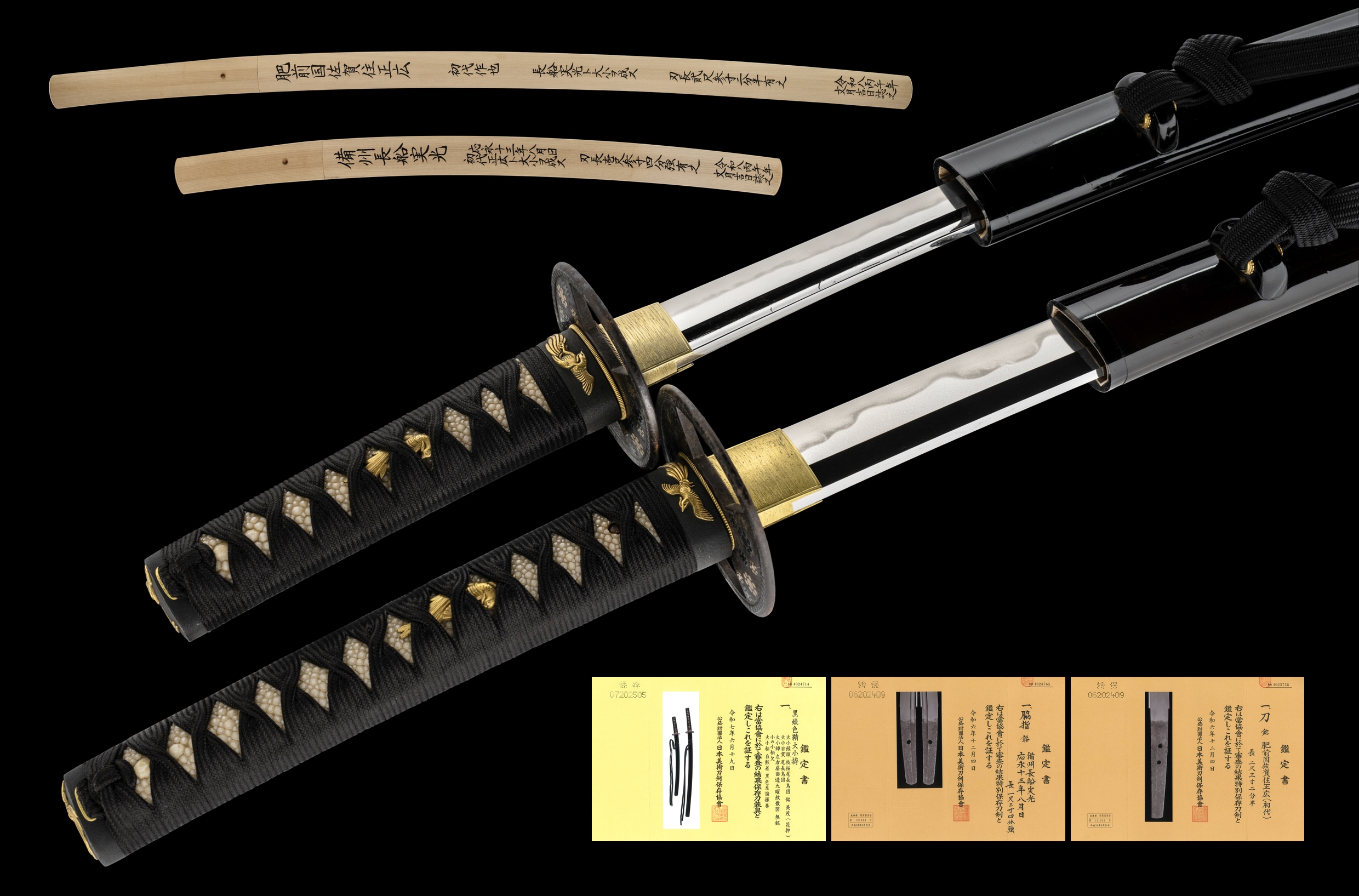
This daishô pairs a katana by first-generation Masahiro of Hizen, made around the Kan’ei era, with a wakizashi by Osafune Sanemitsu dated to the eighth month of Ôei 13 (August 1406). Two blades, two traditions, more than two centuries apart. That was exactly the fashionable move in the Shintô period: a new katana matched with an old Kotô wakizashi, a choice that spoke to the owner’s taste and discernment. Both blades hold NBTHK Tokubetsu Hozon papers, the Edo period daishô koshirae holds its own NBTHK Hozon, and the two tôrokusho were issued on the same day in 2012 with consecutive numbers – these swords have long been kept together as a pair.
Masahiro, grandson of the grandmaster Tadayoshi, adopted his name in Kan’ei 2 (1625) and received the title Kawachi Daijô in 1628. He is regarded as the finest of the Waki-Hizen smiths, and Nabeshima Katsushige, lord of Saga domain, retained him as a private smith. His signature gunome-chôji-midare is in full bloom here, with kawazu-no-ko-chôji, bright nioiguchi, yô and sunagashi set against a dense konuka-hada glittering with ji-nie, rising to a flame-like kaen bôshi. Sanemitsu worked in the Morimitsu line of Ôei-Bizen, Osafune’s golden run of peacetime production, when its blades were a principal export in Ashikaga Yoshimitsu‘s new trade with Ming China. The wakizashi is ubu, showing midare-utsuri and chikei, and its bo-hi still carries traces of carved invocations to Marishiten and Daihi Tamonten, guardian deities worshipped by warriors.
The koshirae is highly classical, tuxedo-like in its formality, and follows the dress code for attending castle ceremonies: glossy black lacquered saya, white samegawa under black ito, and shakudô nanako fuchi-kashira by Yokoya Terushige, later the third-generation Yokoya Eisei, whose gold onagadori birds are echoed on the gold menuki. The iron Higo tsuba carry scattered kuyô-mon, the nine-planet crest of the Hosokawa family, hinting at an owner of real standing in the domain. The katana’s saya has mellowed to a reddish tone beside its partner, decades of sunlight written into the lacquer, and the open kozuka slot on the wakizashi invites the new owner to add a piece of their own choosing. A tsuba from Higo, a katana from Hizen and a wakizashi from Bizen: three provinces, three traditions, one daishô ready for its next steward.
| Item Number | UJDI023 |
| Sword Type | Daishô (katana and wakizashi) |
| Swordsmith (katana) | Shodai Masahiro |
| Swordsmith (JP) (katana) | 肥前國佐賀住正廣 |
| Signature (katana) | Hizen no Kuni Saga jû Masahiro |
| Swordsmith (wakizashi) | Osafune Sanemitsu (first generation) |
| Swordsmith (JP) (wakizashi) | 備州長船實光 / 應永十三年八月日 |
| Signature (wakizashi) | Bishû Osafune Sanemitsu |
| Date (wakizashi) | Ôei jûsan-nen hachigatsu hi – Ôei 13, 8th month (August 1406) |
| School | Hizen Tadayoshi school, Waki-Hizen (katana); Ôei-Bizen, Osafune (wakizashi) |
| Province | Hizen (katana); Bizen (wakizashi) |
| Period | Shintô – Early Edo period, Kan’ei era: 1624-1644 (katana); Kotô – Early Muromachi period, Ôei era: 1394-1428 (wakizashi) |
| Nagasa (katana) | 70.5cm (suriage, machi-okuri; originally approx. 72.8cm) |
| Nagasa (wakizashi) | 40.7cm (ubu) |
| Sori (katana) | 1.3cm |
| Sori (wakizashi) | 0.9cm |
| Moto-haba (katana) | 2.89cm |
| Moto-haba (wakizashi) | 2.48cm |
| Weight (katana) | 660g |
| Weight (wakizashi) | 290g |
| Nakago (katana) | Suriage and machi-okuri, sujikai yasurime, kurijiri, two mekugi-ana |
| Nakago (wakizashi) | Ubu, katte-sagari yasurime, kurijiri, one mekugi-ana |
| Jihada | Finely forged ko-itame forming konuka-hada with ji-nie and chikei; midare-utsuri on the wakizashi |
| Hamon | Gunome-chôji-midare with kawazu-no-ko-chôji and hako-midare, bright nioiguchi, yô, tama and sunagashi |
| Boshi | Kaen (flame-shaped) on the katana |
| Certificates | NBTHK Tokubetsu Hozon (katana, 4 December 2024); NBTHK Tokubetsu Hozon (wakizashi, 4 December 2024); NBTHK Hozon (daishô koshirae, 19 June 2025) |
| Fujishiro Rank | Jô-saku (a superior smith) – Masahiro; Chûjô-saku (an above-average smith) – Sanemitsu |
| Sharpness Rating | Wazamono – Masahiro |
| Sayagaki | Nozomi-san (shodô artist) – both shirasaya, inscribed on a lucky day in the 7th month, Reiwa 8 (July 2026) |
| Koshirae | Edo period kuro-roiro saya daishô koshirae, lacquered in glossy black (NBTHK Hozon); kozuka slot on the wakizashi saya open |
| Tsuba | Iron Higo daishô tsuba, fan-shaped openwork with scattered kuyô-mon crests inlaid in gold and silver, unsigned |
| Fuchi-kashira | Shakudô nanako daishô fuchi-kashira with gold onagadori on a cherry blossom branch, signed 英茂 (Yokoya Terushige) with kaô |
| Menuki | Gold daishô menuki depicting onagadori (long-tailed birds) |
| Tsuka | White samegawa wrapped in black ito, morotsumami-maki style |
| Habaki | Matching gold daishô habaki with copper base |
| Price | $35,000 |
| Status | Available |
| Includes | Two shirasaya with sayagaki, two tsunagi, NBTHK Hozon daishô koshirae, brocade koshirae storage bags, shirasaya bags, kit, three NBTHK certificates, two tôrokusho, printed description |
The PDF contains full photography, detailed blade analysis, and all certification documentation.